I am not quite ready to let the stories end, although it is going to take a concentrated effort to find and share. There is no doubt my experiences in Africa have taken a turn. Some of it is due to familiarity, which renders the once magical into the now understood. On the other hand, I have had a few life events that sent me inward rather than outward. Definitely the arrival of the girl has been one of those events. Going back to school is now another.
I realized that my posts over the past 10 years have created habits of writing that I am going to need to overcome. Links become citations, Google searches become academic searches. It is not so different, perhaps, but just more thorough and requiring more structure. On a positive note, I look at an assignment requiring 7-10 pages and my only problem is how I will limit my thoughts to such a short paper.
And of course, as I've already written, Bamako seems to be the quiet years for me. I have not had the opportunity to travel much nor the motivation to see many sights within the city. And now, before we know it, our African journey will take us to yet another country. A new adventure awaits, especially since I had never really planned on visiting Nigeria, and yet, in a few short months, we will be living there full time.
I am wondering what I will remember about Bamako and Malian culture. Once I find out we're leaving, there is always a slight need to pack in a bunch of sensations and experiences. I took several photos of my full studio and Drissa and I will make a short video about our painting together. It is definitely one of the highlights of being here. We both recognize that it is not an everyday opportunity to paint and create with someone on the same canvas. It's not likely to happen again soon for either of us.
There will also be the final exhibition of our work and dance performance. That will feel like a real send off. A finale of sorts.
Until then, I am buys trying to usher my students through the final months of school. Never an easy task in middle school. The students in my performing arts class were preoccupied with the school strikes happening in the city. One student worried that the strikers would show up at our school.
It's not the first time I have heard this. It happened several times in Abidjan as well. The local schools go on strike and then respond, often aggressively, when the private schools don't follow suit. It is a challenging situation to be in, for certain, but forcing schools to close by pulling students out of classes and making threats on campus doesn't seem like it will do much to further the cause.
My students were adamant that the strikers had gone to the French school and tear gas was involved. Perhaps they confused it with this, which seems to discuss parents concerned about the security situation in Bamako and the potential closure of the French school. I searched for news of something more, but was unable to find anything. Which doesn't mean it didn't happen. It just means it is not making headlines. No surprise there.
What did come up in my Google search was a wealth of stories about strikes and the possibility of 'l'année blanche,' meaning a school year wasted. Not enough time in classrooms for children to learn, not open during testing, and no advancement. Everyone will have to repeat, spending next year in the same grade they were in this year.
The articles come from as far back as 2004. These articles are from 2008 and 2017, and in the latter, the role of private schools is explicitly discussed. Many students coming from the north who have fled violence there, were taken in by the public schools for free and this has led to an imbalance of shouldering the responsibility for the advancement of the country between public and private schools. In 2019 the problems continue. Teachers are demanding better working conditions, including increased salary (or even a salary. Demanding pack pay is mentioned, suggesting that teachers are not and have not been getting paid. Housing allowance is also a point.) These are not new problems.
This post from 2012 explains the problem well. Schools take so long to get going, and then the inevitable happens- holidays, political unrest, terrorism- which requires more breaks and before you know it, the year has passed with the number of actual classes held in the single digits. Not much learning exchange takes place and those who do manage to pass, only do so because they have taken it on themselves to figure out the material. Or they have paid.
This notice from Dec 2018 is within this school year and serves to show that multiple disruptions prevent fluid and engaged learning from taking place. A fifteen day strike has been called, to occur in three phases from March to April, which seems to signal no end to the disruptions for students.
The problem, cited here and here is that the children of the government officials are often not in public schools. The end result is that the masses suffer from decisions made by the elite, who are not affected in any way. Parent associations do not seem to be stepping up to provide support either. Overall, the complicated problem, ongoing since 2016 when talks in this round first began, seems bound to continue. The damage to generations of children and the future of the country is at stake.
Meanwhile, as children worldwide protest climate change, Malian students are just hoping for the chance at an uninterrupted education.
17.3.19
29.1.19
the quiet years
I'm supposed to be writing a paper. Any writer worth their salt will recognize this post as distraction. And it is. But it is also filled with nostalgia. I was browsing through previous posts ( I thought there was one or two that might make interesting vignettes in my paper, really, I was here with academic intention) and realized it's not the first time I've reflected on my quality and quantity of writing. Which is essentially a reflection on my quality and quantity of living.
If Abidjan was the lost years, years spent in shock over a break up and then trying to pick up the pieces and see a way forward, Bamako seems like the silent years. The quiet years. The lonely years. I have an idea or two kicking around for an interesting post, but mostly, it's not happening. You know. You can see. My absence is telling.
I have just another excuse now, the doctorate program is going to eat up all my time. Already I feel like it is a race to read everything (which we were told on the first day of classes by one professor that it is unlikely we will actually be able to read all assignments. The student council welcomed us with a powerpoint including tips on "how to gut a book" and other grad school strategies for understanding without reading every page.) I am determined to read as much as possible, though, and have succeeded only in feeling as though I will mix up all my references and attribute quotes to wrong authors and babble incoherently.
Luckily, or not, many of the ideas overlap and support each other. Another student made reference to the same worries as she posted a comment and then wrote, "I hope that is the right reference. So much reading!" Yes, we are feeling it.
The one thing I am not feeling is the stress of getting it done. I don't have other things- or people- pulling at my time. The routine is set. Mbalia gets her hours and once she is in bed, I am free to work (or procrastinate by writing here. But it is likely, I will be on hiatus- after my next post about perspective and painting and the feelings this city evokes in me.)
Bamako is pretty empty for me, though a friend just shared a video clip of Dogon dancers in a festival downtown. Everything starts so unpredictably, and the traffic creates such long lines and late nights. I am not interested. I would rather walk the neighborhood with my girl and get excited about the white horse or a fun little hill to climb. She still wonders at the sounds of the goats and searches the skies for bats. This morning we happened to be up with the stars and she couldn't stop remarking on their beauty, especially when coupled with the moon.
While I have fleeting moments of guilt- I should expose her to culture and take her to the masked dance, I myself might have enjoyed the masked dance, but I see it all as a trade off in time. For now, it's good enough, the girl and I hanging together, doing my studies, a little yoga. These quiet years won't last forever. All things are temporary.
I might try to write more often- or at least once a month. I might try to notice how Bamako is different, unique, magical. But I might also try to get through my studies, love my girl and look forward to our next spot, which will hopefully be ever closer to home.
If Abidjan was the lost years, years spent in shock over a break up and then trying to pick up the pieces and see a way forward, Bamako seems like the silent years. The quiet years. The lonely years. I have an idea or two kicking around for an interesting post, but mostly, it's not happening. You know. You can see. My absence is telling.
I have just another excuse now, the doctorate program is going to eat up all my time. Already I feel like it is a race to read everything (which we were told on the first day of classes by one professor that it is unlikely we will actually be able to read all assignments. The student council welcomed us with a powerpoint including tips on "how to gut a book" and other grad school strategies for understanding without reading every page.) I am determined to read as much as possible, though, and have succeeded only in feeling as though I will mix up all my references and attribute quotes to wrong authors and babble incoherently.
Luckily, or not, many of the ideas overlap and support each other. Another student made reference to the same worries as she posted a comment and then wrote, "I hope that is the right reference. So much reading!" Yes, we are feeling it.
The one thing I am not feeling is the stress of getting it done. I don't have other things- or people- pulling at my time. The routine is set. Mbalia gets her hours and once she is in bed, I am free to work (or procrastinate by writing here. But it is likely, I will be on hiatus- after my next post about perspective and painting and the feelings this city evokes in me.)
Bamako is pretty empty for me, though a friend just shared a video clip of Dogon dancers in a festival downtown. Everything starts so unpredictably, and the traffic creates such long lines and late nights. I am not interested. I would rather walk the neighborhood with my girl and get excited about the white horse or a fun little hill to climb. She still wonders at the sounds of the goats and searches the skies for bats. This morning we happened to be up with the stars and she couldn't stop remarking on their beauty, especially when coupled with the moon.
While I have fleeting moments of guilt- I should expose her to culture and take her to the masked dance, I myself might have enjoyed the masked dance, but I see it all as a trade off in time. For now, it's good enough, the girl and I hanging together, doing my studies, a little yoga. These quiet years won't last forever. All things are temporary.
I might try to write more often- or at least once a month. I might try to notice how Bamako is different, unique, magical. But I might also try to get through my studies, love my girl and look forward to our next spot, which will hopefully be ever closer to home.


9.1.19
Among the Americans
Despite the somewhat dismal previous post about the state of 2019, the new year promises to bring plenty of positives as well. Personally, it is the start of a new kind of journey, one dedicated to scholarly pursuit and fulfillment of a dream. Several dreams, actually. And it is super exciting.
I am here in the US, among the Americans. It definitely feels that way. My stateside experiences have become colored through various lenses and many have written about the reverse culture shock of trying to return home. But, as happens for many immigrants, the more time away and the more time spent in another culture creates permanent shifts. I am American, of course, but it feels like American plus...or maybe American minus. They feel different. I feel different, like an outsider looking in.
The relationship with food is the thing most standing out to me this time. Other things like race and religion, of course. You can't go to America without talking race and religion. The thing about the food issue is that no one is talking about it, and no one seems aware of it.
Americans eat a lot. All the time. I am here starting classes- the days are filled with 2 hour classes, usually followed by a few hours break and then another class. There are required dinners and optional presentations in-between. There is an hour for lunch on your own.
No matter what class I am in- before lunch, after lunch, after the required dinner, someone is eating. Sometimes it is the same someones, munching their way through every class. Last night I was at a student presentation- his final capstone project on popular music influence and the legacy of MLK. It was an engaging presentation and a huge project. People were rattling bags and snacking and even eating an entire salad. I was stunned. I am continually stunned.
I wondered why she couldn't wait an hour to eat her salad? Or what had she done with the hour before this presentation that prevented her from eating? I am stunned at the disrespect to the presenter, the inability to wait for an appropriate time and also, and perhaps most importantly, the inability to be truly present- either with the salad or the presenter.
Eating your food while attending a discussion class (because, let's face it, all of these higher ed classes are going to be discussion classes and with themes like ethical leadership and cultural differences, it's going to be full of hot conversations) seems the epitome of conflict. Are you going to be eating or talking?
While, to me, it appears disrespectful to the professors or the presenters to be eating, often I notice the snackers are not really paying attention to their food anyway; it is a mindless eating. Which makes me wonder all the more why they are doing it, at this moment? Surely the salad would be so much more enjoyable and fulfilling if you were to sit and eat it and enjoy it. Be present with it. Make it a meal, understand the sacredness of food. The gift of food.
It's what is missing. The idea that food - as a nourishing entity, is not only essential but sacred. And deserves our attention, our gratefulness, our presence.
The same can be said for the conversation, the presentation, the class. We are here to engage with others- in person- for a short time before we continue our virtual studies together. This is a fleeting moment to connect with our classmates, to put nuances in manner of habit and speaking together to try and understand perspectives and backgrounds that we are each bringing to the experience. It is a short moment to observe and connect. Why is your attention diverted? Why is this time, my time, not sacred to you?
I am appalled by this, the Americans' inability to be present, to be in the moment, to recognize the sacred. I am stunned. Mostly because I had naively assumed this was a problem only amongst my middle school students. Perhaps I haven't been getting out enough. Surely I haven't been in many social circles. Maybe it is not an American affliction- perhaps it is a human condition. In either case, in any case, it is detrimental to our social connections and our social need. All other benefits aside, this is one aspect I am not enjoying among the Americans.
I am here in the US, among the Americans. It definitely feels that way. My stateside experiences have become colored through various lenses and many have written about the reverse culture shock of trying to return home. But, as happens for many immigrants, the more time away and the more time spent in another culture creates permanent shifts. I am American, of course, but it feels like American plus...or maybe American minus. They feel different. I feel different, like an outsider looking in.
The relationship with food is the thing most standing out to me this time. Other things like race and religion, of course. You can't go to America without talking race and religion. The thing about the food issue is that no one is talking about it, and no one seems aware of it.
Americans eat a lot. All the time. I am here starting classes- the days are filled with 2 hour classes, usually followed by a few hours break and then another class. There are required dinners and optional presentations in-between. There is an hour for lunch on your own.
No matter what class I am in- before lunch, after lunch, after the required dinner, someone is eating. Sometimes it is the same someones, munching their way through every class. Last night I was at a student presentation- his final capstone project on popular music influence and the legacy of MLK. It was an engaging presentation and a huge project. People were rattling bags and snacking and even eating an entire salad. I was stunned. I am continually stunned.
I wondered why she couldn't wait an hour to eat her salad? Or what had she done with the hour before this presentation that prevented her from eating? I am stunned at the disrespect to the presenter, the inability to wait for an appropriate time and also, and perhaps most importantly, the inability to be truly present- either with the salad or the presenter.
Eating your food while attending a discussion class (because, let's face it, all of these higher ed classes are going to be discussion classes and with themes like ethical leadership and cultural differences, it's going to be full of hot conversations) seems the epitome of conflict. Are you going to be eating or talking?
While, to me, it appears disrespectful to the professors or the presenters to be eating, often I notice the snackers are not really paying attention to their food anyway; it is a mindless eating. Which makes me wonder all the more why they are doing it, at this moment? Surely the salad would be so much more enjoyable and fulfilling if you were to sit and eat it and enjoy it. Be present with it. Make it a meal, understand the sacredness of food. The gift of food.
It's what is missing. The idea that food - as a nourishing entity, is not only essential but sacred. And deserves our attention, our gratefulness, our presence.
The same can be said for the conversation, the presentation, the class. We are here to engage with others- in person- for a short time before we continue our virtual studies together. This is a fleeting moment to connect with our classmates, to put nuances in manner of habit and speaking together to try and understand perspectives and backgrounds that we are each bringing to the experience. It is a short moment to observe and connect. Why is your attention diverted? Why is this time, my time, not sacred to you?
I am appalled by this, the Americans' inability to be present, to be in the moment, to recognize the sacred. I am stunned. Mostly because I had naively assumed this was a problem only amongst my middle school students. Perhaps I haven't been getting out enough. Surely I haven't been in many social circles. Maybe it is not an American affliction- perhaps it is a human condition. In either case, in any case, it is detrimental to our social connections and our social need. All other benefits aside, this is one aspect I am not enjoying among the Americans.
2.1.19
the state of 2019
Mexico is paying for the wall
Jair Bolsonaro has been sworn in
JK is hoping for annulled elections due to their chaotic implementation - eerily familiar to this 2011 outcome
Madagascar is crying foul too,
Sudan is having its own economic crisis, and protests for elections
No internet in either of those countries...
China and Taiwan continue
Nicaragua
West Africa is a mess....
Niger
Nigeria
Mali
Burkina Faso
Algeria
then there are natural disasters
women's issues
Saudi Arabia
children dying
children are dying
and more children are dying
there's a lot of work to do.
unless you're in the US gov. in which case, no work at all.
Jair Bolsonaro has been sworn in
JK is hoping for annulled elections due to their chaotic implementation - eerily familiar to this 2011 outcome
Madagascar is crying foul too,
Sudan is having its own economic crisis, and protests for elections
No internet in either of those countries...
China and Taiwan continue
Nicaragua
West Africa is a mess....
Niger
Nigeria
Mali
Burkina Faso
Algeria
then there are natural disasters
women's issues
Saudi Arabia
children dying
children are dying
and more children are dying
there's a lot of work to do.
unless you're in the US gov. in which case, no work at all.
1.1.19
Talking to yourself and other strategies for maintaining control
It's come and gone- the tensely awaited election day in Congo. While it didn't go as badly as it could have- some people actually got to vote- it certainly didn't qualify for a 'free and fair democratic election.' Voting stations didn't open, those that did faced- to no one's surprise- electricity problems that prevented the electronic voting machines from functioning properly. Voters couldn't find their names on the list, they didn't have time to wait in long lines, long lines pushed and shoved and refused to be orderly. Persistent voters in Beni organized their own process after being excluded from the election, along with several other cities, by the capital.
None of this is surprising. I think despite a fragile hope that these elections would somehow give way to new leadership in Kinshasa, all signs point to JK holding onto power by any means necessary. The part I can't quite fathom is the talking yourself into it. How does he manage to convince himself of what he is doing? Any trek outdoors makes it clear that the population is not in support of this.
I wonder also at the coordination between so many players. How do they all face themselves each morning? They must resort to adding preprinted ballots, menacing voters, and other techniques of cheating and lying. Perhaps the money they stand to gain is worth it all. Perhaps they really believe in what they are doing.
I was reminded of a book I'd recently read about rewiring negative messages from the past. The book discusses the science behind changing messages we tell ourselves everyday that ultimately lead to defeat. One of the biggest criteria for changing old ideas is simply repetition. In order to create new neural pathways, one has only to repeat an action, a thought, a behavior enough times to create a new roadway for it to become habit. Helmstetter writes, "programming creates beliefs, beliefs create attitudes, attitudes create feelings, feelings determine actions, actions create results." His main idea being that it all starts with the stories we tell ourselves. If we truly want to create outer change, we must make changes to the input first.
It makes good sense. The mind has incredible powers of manifesting the information it hears. We're just not always aware of the information going in- or we don't take the necessary time to monitor, filter, and protect our thoughts from damaging information. If I am ready to believe this will work for me, then I must believe it is the way those holding onto power in the DRC get through each day.
They simply repeat to themselves that they are in power, they deserve power and their lives depend on it. They are willing to do anything, including murder their own citizens, in order to maintain access to the millions they cypher each year.
But in reality, simply repeating something doesn't make it true. Not when there are others involved, a whole country of people rallying against you. You can't just talk your way into a dictatorship- or can you?
The American government has ordered its citizens to leave the country. The email was rather blunt.
So what makes this time so different that the US government has decided to call for departure from the country? Once again the Congolese are left to fight the battle themselves. Despite the many social media posts, there are few articles about the election process or its aftermath, and among them, the language seems tame.
The ruling party is pulling out all tricks for maintaining control. It seems like the international community is busy talking itself into alternate realities as well. It's up to the population now to take matters into their own hands. Courage to the Congolese for 2019.
None of this is surprising. I think despite a fragile hope that these elections would somehow give way to new leadership in Kinshasa, all signs point to JK holding onto power by any means necessary. The part I can't quite fathom is the talking yourself into it. How does he manage to convince himself of what he is doing? Any trek outdoors makes it clear that the population is not in support of this.
I wonder also at the coordination between so many players. How do they all face themselves each morning? They must resort to adding preprinted ballots, menacing voters, and other techniques of cheating and lying. Perhaps the money they stand to gain is worth it all. Perhaps they really believe in what they are doing.
I was reminded of a book I'd recently read about rewiring negative messages from the past. The book discusses the science behind changing messages we tell ourselves everyday that ultimately lead to defeat. One of the biggest criteria for changing old ideas is simply repetition. In order to create new neural pathways, one has only to repeat an action, a thought, a behavior enough times to create a new roadway for it to become habit. Helmstetter writes, "programming creates beliefs, beliefs create attitudes, attitudes create feelings, feelings determine actions, actions create results." His main idea being that it all starts with the stories we tell ourselves. If we truly want to create outer change, we must make changes to the input first.
It makes good sense. The mind has incredible powers of manifesting the information it hears. We're just not always aware of the information going in- or we don't take the necessary time to monitor, filter, and protect our thoughts from damaging information. If I am ready to believe this will work for me, then I must believe it is the way those holding onto power in the DRC get through each day.
They simply repeat to themselves that they are in power, they deserve power and their lives depend on it. They are willing to do anything, including murder their own citizens, in order to maintain access to the millions they cypher each year.
But in reality, simply repeating something doesn't make it true. Not when there are others involved, a whole country of people rallying against you. You can't just talk your way into a dictatorship- or can you?
The American government has ordered its citizens to leave the country. The email was rather blunt.
Security Alert - U.S. Embassy Kinshasa, Democratic Republic of the Congo (December 31, 2018)
Location: DRC, countrywide
Event: The government of the DRC shut down internet services on December 31 in the aftermath of the elections. Phone lines are still a functioning way of communication.
Actions to Take:
It goes on to list other steps, but really, after the first one what more information do you need? However, this is not the first time the government has blocked the internet and phone systems. I recall something quite similar during the last elections. And several times in between.
Depart the country.
So what makes this time so different that the US government has decided to call for departure from the country? Once again the Congolese are left to fight the battle themselves. Despite the many social media posts, there are few articles about the election process or its aftermath, and among them, the language seems tame.
The ruling party is pulling out all tricks for maintaining control. It seems like the international community is busy talking itself into alternate realities as well. It's up to the population now to take matters into their own hands. Courage to the Congolese for 2019.
30.12.18
Where artists work
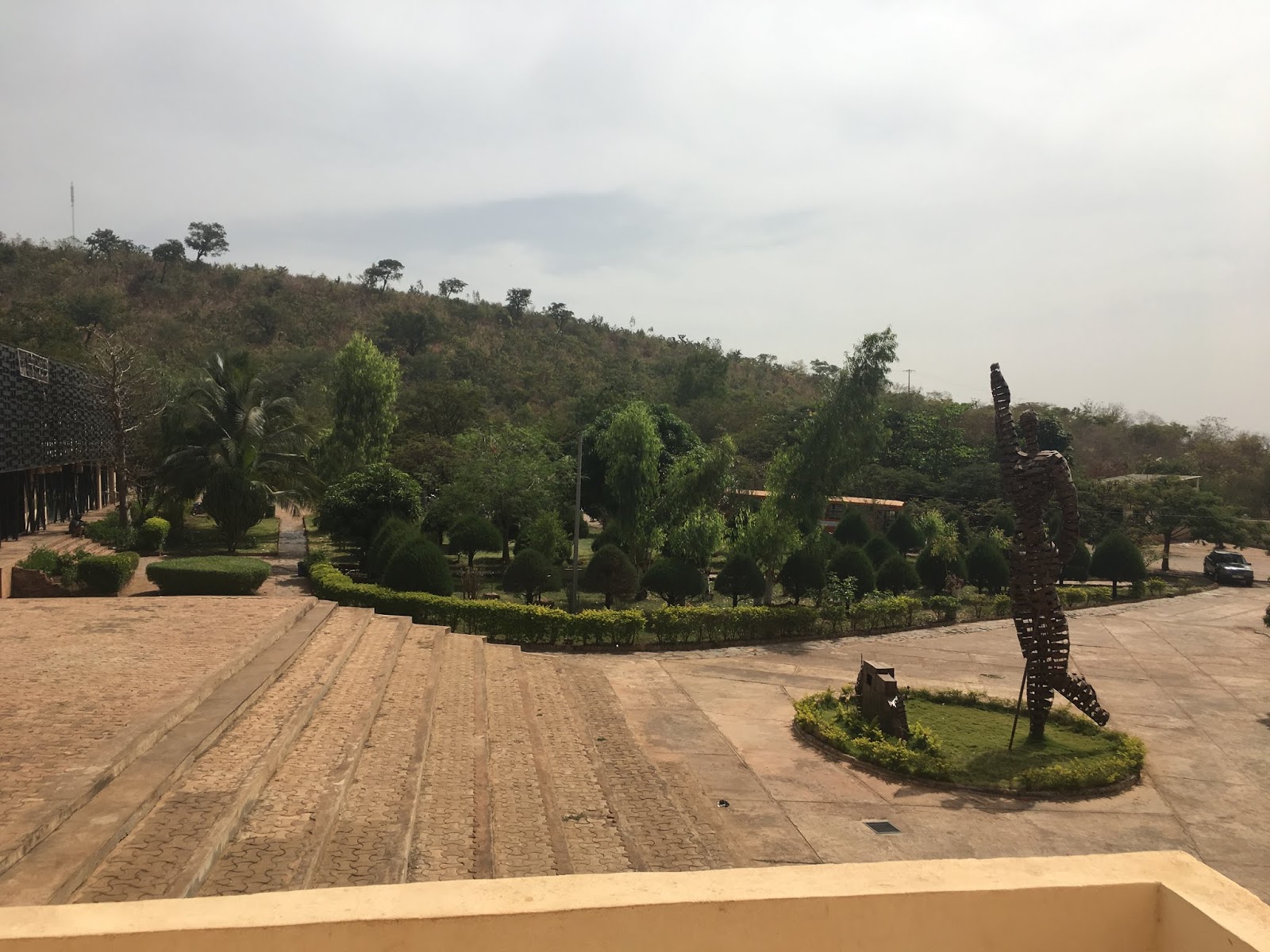
We've taken to organizing field trips, a colleague and I, to see places where artists work around Bamako. The Conservatoire was an interesting study in architecture. The school suffers a bit from a bad reputation around town, but the place itself is quite grand. We were surprised to see students on the grounds, though many less than could be accommodated.


A visiting couple from France were on hand to offer a workshop, which likely led to the ambiance in the visual art department. Students filled one of the well lit rooms, their drawings taped to the wall and others spilled out into the hallway, lining the corridor as they surveyed their work. The project theme was something about a city on the head. Students had imagined various hats depicting their ideas of a city. Pencil drawings were taped above current images being completed in color pastels. The final stage of the project involves turning these drawings into 3D sculptures that can actually be worn.

While it was clear this was student work, some were quite intriguing. Ideas varied from futuristic cities with cubist design to traditional Malian village scenes with a twist. One of my favorites showed a veiled desert inhabitant with a hat of elongated buildings in the Djenne mosque style.
The French teacher struck up a conversation with us about exhibit space. It seemed she had done this workshop in previous years and was once again looking for the perfect spot to showcase the final works. After the rest of our tour, I reflected on this request as somewhat curious.
The Conservatoire also includes a spacious performance building with stage and lights- surely enough room to host a beautiful exhibit of student work. There is a restaurant on campus and plenty of outdoor space to create a cafe like atmosphere. I wondered why the campus itself wouldn't be the perfect showcase choice.

Part of it may be due to the secluded location. In order to access the Conservatoire, you must pass just outside of town, up a winding hill and down a long, albeit marvelously paved, road. But as a strategy for increasing the reputation of the school and garnering public interest, I would think they would be doing everything they could to have events and highlight the place.
We must have lingered a bit too long, talking and eyeing the student work because we lost our guide here. But we were happy enough to wander around the rest of the campus peeking into doorways and generally intruding on anyone we found working. There was a department for music and some students could be heard practicing jazz or classical piano. The dance building hosted room after room of empty studios. Several students were in the main rehearsal space, accompanied by a few djembe drummers. It was all very tame and subdued. The space was built to accommodate a greater number of students and so it appeared empty despite the activities going on.

Peering out of one of the upstairs studio windows gave us a view of a group of students clustered in an outdoor gazebo, possibly painting. An administrator or two were tucked away in offices and a group of men sat under a tree in deep discussion. A teacher preparing his lessons was discovered in a drawing room filled with easels and incredible light.

The potential seemed apparent, though the reality still has a bit of catching up to do.


Our second trip to visit Abdoul, an artist and theater designer, was in stark contrast to the large buildings and open campus of the Conservatoire. Like many artists, Abdoul works out of his house, though he also mentioned a much larger space just outside the city. His neighborhood was lively and filled with children in the streets and teens huddled together outside their houses, sitting in chairs or hanging around motorcycles.
His studio was intimate, a collage of covered and open outdoor space, filled with canvases, sculptures and random theater props all in various stages of completion. There were power sanders- for making organic pigments- his current passion. And of course, the stones and bricks ready to be sanded down into painting material. There were also industrial sized buckets of acrylic paint used to bring form and light to the burlap backdrops. The technical section included computers and tablets, and wires of all sorts. He showed us various film clips, both finished and in progress, both financed and on-his own.
He is currently working on a Christian theme, a client request. But he has become enthralled by the use of gold leaf paper and monochrome palettes and imagines taking the theme further to a juxtaposition of religious ideology.
Abdoul talked about the elements of creating his art- the late night hours when the neighborhood is quiet, the effect of light to change a work completely. He even demonstrated for us using several of the stage lights he had installed along a ceiling support. A few were also laying around the ground in easy reach.
It was a place of creativity and action. A place of conversation, with low chairs, elaborately carved thrones and abstract figures that doubled as possible seating. We were there for hours listening to a summary of his work, his artistic philosophy and his current projects.
It is a constant fascination of mine to learn how these artists become successful. Often a chance meeting leads to one connection or another that leads to a project. Other times an embassy will be in direct contact, requesting specific work, or a gallery owner will stop by with an idea in mind, only to discover new dimensions that were unknown before. And viola, a new project is born.
Abdoul spent several years traveling and working with some of the greats in filmmaking and art. He is accomplished and successful and feels better staying home now. He creates because he must and he is dedicated to seeing through some of his own ideas for telling the history of Mali through fiction films that allow him to use his talents for costume design and setting.
It's the struggle of artists everywhere. Finding the balance between making art of your own creation and providing others with their desire. Financing is always necessary which often means compromise.
We seemed to have come full circle- visiting an artist at this stage of his career. It was interesting to compare to our earlier visit to designer Chiek Diallo, another long time, successful artist and to remember the young students at the Conservatoire, to imagine how one might evolve in their own artistic journey to this point of confidence and conviction.


A visiting couple from France were on hand to offer a workshop, which likely led to the ambiance in the visual art department. Students filled one of the well lit rooms, their drawings taped to the wall and others spilled out into the hallway, lining the corridor as they surveyed their work. The project theme was something about a city on the head. Students had imagined various hats depicting their ideas of a city. Pencil drawings were taped above current images being completed in color pastels. The final stage of the project involves turning these drawings into 3D sculptures that can actually be worn.

While it was clear this was student work, some were quite intriguing. Ideas varied from futuristic cities with cubist design to traditional Malian village scenes with a twist. One of my favorites showed a veiled desert inhabitant with a hat of elongated buildings in the Djenne mosque style.
The French teacher struck up a conversation with us about exhibit space. It seemed she had done this workshop in previous years and was once again looking for the perfect spot to showcase the final works. After the rest of our tour, I reflected on this request as somewhat curious.
The Conservatoire also includes a spacious performance building with stage and lights- surely enough room to host a beautiful exhibit of student work. There is a restaurant on campus and plenty of outdoor space to create a cafe like atmosphere. I wondered why the campus itself wouldn't be the perfect showcase choice.

Part of it may be due to the secluded location. In order to access the Conservatoire, you must pass just outside of town, up a winding hill and down a long, albeit marvelously paved, road. But as a strategy for increasing the reputation of the school and garnering public interest, I would think they would be doing everything they could to have events and highlight the place.
We must have lingered a bit too long, talking and eyeing the student work because we lost our guide here. But we were happy enough to wander around the rest of the campus peeking into doorways and generally intruding on anyone we found working. There was a department for music and some students could be heard practicing jazz or classical piano. The dance building hosted room after room of empty studios. Several students were in the main rehearsal space, accompanied by a few djembe drummers. It was all very tame and subdued. The space was built to accommodate a greater number of students and so it appeared empty despite the activities going on.

Peering out of one of the upstairs studio windows gave us a view of a group of students clustered in an outdoor gazebo, possibly painting. An administrator or two were tucked away in offices and a group of men sat under a tree in deep discussion. A teacher preparing his lessons was discovered in a drawing room filled with easels and incredible light.

The potential seemed apparent, though the reality still has a bit of catching up to do.


Our second trip to visit Abdoul, an artist and theater designer, was in stark contrast to the large buildings and open campus of the Conservatoire. Like many artists, Abdoul works out of his house, though he also mentioned a much larger space just outside the city. His neighborhood was lively and filled with children in the streets and teens huddled together outside their houses, sitting in chairs or hanging around motorcycles.
His studio was intimate, a collage of covered and open outdoor space, filled with canvases, sculptures and random theater props all in various stages of completion. There were power sanders- for making organic pigments- his current passion. And of course, the stones and bricks ready to be sanded down into painting material. There were also industrial sized buckets of acrylic paint used to bring form and light to the burlap backdrops. The technical section included computers and tablets, and wires of all sorts. He showed us various film clips, both finished and in progress, both financed and on-his own.
He is currently working on a Christian theme, a client request. But he has become enthralled by the use of gold leaf paper and monochrome palettes and imagines taking the theme further to a juxtaposition of religious ideology.
Abdoul talked about the elements of creating his art- the late night hours when the neighborhood is quiet, the effect of light to change a work completely. He even demonstrated for us using several of the stage lights he had installed along a ceiling support. A few were also laying around the ground in easy reach.
It was a place of creativity and action. A place of conversation, with low chairs, elaborately carved thrones and abstract figures that doubled as possible seating. We were there for hours listening to a summary of his work, his artistic philosophy and his current projects.
It is a constant fascination of mine to learn how these artists become successful. Often a chance meeting leads to one connection or another that leads to a project. Other times an embassy will be in direct contact, requesting specific work, or a gallery owner will stop by with an idea in mind, only to discover new dimensions that were unknown before. And viola, a new project is born.
Abdoul spent several years traveling and working with some of the greats in filmmaking and art. He is accomplished and successful and feels better staying home now. He creates because he must and he is dedicated to seeing through some of his own ideas for telling the history of Mali through fiction films that allow him to use his talents for costume design and setting.
It's the struggle of artists everywhere. Finding the balance between making art of your own creation and providing others with their desire. Financing is always necessary which often means compromise.
We seemed to have come full circle- visiting an artist at this stage of his career. It was interesting to compare to our earlier visit to designer Chiek Diallo, another long time, successful artist and to remember the young students at the Conservatoire, to imagine how one might evolve in their own artistic journey to this point of confidence and conviction.
25.12.18
No comment- stories of Malian tradition
I am getting farther and farther away from things I know and understand. This is supposed to be a good exercise in growth and personal reflection. Instead it's become something of a circular road. Drissa and I have been working on a painting series for many months now. It began as a tribute and recording of traditional dance- the why, the how, the when. Our series of paintings is meant to be transformed into children's books that detail the history of traditional dances.
But as the first project nears an end, we have travelled far from things I find familiar. Drissa must start the skeleton outline of each of these compositions, as I can't even begin to imagine the scenery. I am tasked with writing the story to accompany our paintings. A children's story. Somehow, I must find the child words to talk about the tradition of jabbi- painting henna on the hands in a certain color before the wedding- this color to be revealed at the big dance ceremony- this color to signify if the woman was 'innocent' before marriage or.....not. Who would say they weren't? I wonder.
But Drissa assures me that the women know if they start their marriage with dishonesty, it will bring bad luck. I suspect he doesn't really have the answers to my questions, and if I am going to be able to write the book, I will need to find a woman to pose my many questions to.
We are on the last of the images. Currently we are working on the seclusion. A period of 3-5 days when the woman must stay in the house of her husband. She can receive visitors, but she can't go out.
As Drissa fills in the details, my questions mount. How am I ever going to turn this into 'kid-friendly?" He tells me normally the woman wears a cloth but not much else. I suspect this is so she will be "ready" for her husband, at any moment. He also talks about the displaying of the sheets- the blood stained cloth that is hung outside the hut to prove her innocence to everyone in the village. Except he explains it as a cause of celebration- she is passing from a young girl to a woman.
I am of two minds here, as so much of tradition inspires. It is good to celebrate passages of age and life stages, something I believe America has lost. I believe this lost rite of passage has become the cause of much confusion and disrespect in youth. But the public airing of your most intimate life? I am not sure I can get behind that one.
Isn't it really a way to control women and keep a firm male dominance in place? I think it will be better to leave this part out- of the painting and the story. Instead, we have a woman sitting on her mat, wrapped in white cloth sharing oranges with someone who has come to offer gifts.
"She is like a queen," Drissa insists. "She sits and doesn't do anything but wait patiently while others serve her." I don't see it quite that way. Prisoner is what comes to my Western mind. Or maybe it is my female mind. I wonder how Malian women view this tradition.
He agrees that it is something that happens rarely now. He laughs a bit, saying young girls don't always wait for their husband. But I know that, too, is a perspective he can't really offer with truth. Young girls these days are coerced by their school professors and strangled by the poverty that faces them. They often have little choice, and the choices they do make, don't really belong to them.
Last year his own sister was married off- at the tender age of 18. Perhaps even a bit old by Malian standards. The brothers protested, but I imagine it was a feeble attempt to get their parents to permit their sister to continue her education. There isn't much of a promising life at the end of that road.
Schools in Mali still need a lot of positive PR. The university system is even worse, spending more time closed than open. Students, like Issa, Drissa's younger brother, may find their names on two lists at the end of exams. If they pay a little something, they can get their name off the failing list and permanently inscribed on the passing list. And if they don't...? They take the course again, or drop out altogether.
Isssa has chosen to continue his studies, but he concentrates on painting for a future. They find a lot of mural work for restaurants and embassies, and Issa has secured a few small jobs painting ads on the outside of barbershops and groceries.
As for our painting series, we hope to be finished by February. The paintings really are beautiful and likely to garner much admiration- that Western kind that ogles over day to day scenes of ordinary life, finding a charm on the surface that may not exist in reality.
If we do a second set, I would like to focus more on the dance and the movements. A kind of abstract expression of the beauty of human form and capability. The dances are beautiful, and powerful. There is a transformative effect when one takes up the traditional movements- and it complicates the real life details.
I am getting better at living in two minds, accepting conflicting details of beauty and oppression. Because sometimes, life is just that way. I think it might help to look at it as history. Transcribing the past traditions. But it is a challenge to write about something that I disagree with. I admit the pages sound stilted and factual. I find it difficult to infuse passion and magic. I am not sure if the story is beautiful, or if it is even meant to be beautiful. Maybe it is just meant to be history. Without judgement or comment or personal interpretation. Maybe this is what I need to remember to transform this ritual into a child's book - I am merely recording lessons of their history, their culture and their country. Perhaps they will view it as a record of their progress. One day.
But as the first project nears an end, we have travelled far from things I find familiar. Drissa must start the skeleton outline of each of these compositions, as I can't even begin to imagine the scenery. I am tasked with writing the story to accompany our paintings. A children's story. Somehow, I must find the child words to talk about the tradition of jabbi- painting henna on the hands in a certain color before the wedding- this color to be revealed at the big dance ceremony- this color to signify if the woman was 'innocent' before marriage or.....not. Who would say they weren't? I wonder.
But Drissa assures me that the women know if they start their marriage with dishonesty, it will bring bad luck. I suspect he doesn't really have the answers to my questions, and if I am going to be able to write the book, I will need to find a woman to pose my many questions to.
We are on the last of the images. Currently we are working on the seclusion. A period of 3-5 days when the woman must stay in the house of her husband. She can receive visitors, but she can't go out.
As Drissa fills in the details, my questions mount. How am I ever going to turn this into 'kid-friendly?" He tells me normally the woman wears a cloth but not much else. I suspect this is so she will be "ready" for her husband, at any moment. He also talks about the displaying of the sheets- the blood stained cloth that is hung outside the hut to prove her innocence to everyone in the village. Except he explains it as a cause of celebration- she is passing from a young girl to a woman.
I am of two minds here, as so much of tradition inspires. It is good to celebrate passages of age and life stages, something I believe America has lost. I believe this lost rite of passage has become the cause of much confusion and disrespect in youth. But the public airing of your most intimate life? I am not sure I can get behind that one.
Isn't it really a way to control women and keep a firm male dominance in place? I think it will be better to leave this part out- of the painting and the story. Instead, we have a woman sitting on her mat, wrapped in white cloth sharing oranges with someone who has come to offer gifts.
"She is like a queen," Drissa insists. "She sits and doesn't do anything but wait patiently while others serve her." I don't see it quite that way. Prisoner is what comes to my Western mind. Or maybe it is my female mind. I wonder how Malian women view this tradition.
He agrees that it is something that happens rarely now. He laughs a bit, saying young girls don't always wait for their husband. But I know that, too, is a perspective he can't really offer with truth. Young girls these days are coerced by their school professors and strangled by the poverty that faces them. They often have little choice, and the choices they do make, don't really belong to them.
Last year his own sister was married off- at the tender age of 18. Perhaps even a bit old by Malian standards. The brothers protested, but I imagine it was a feeble attempt to get their parents to permit their sister to continue her education. There isn't much of a promising life at the end of that road.
Schools in Mali still need a lot of positive PR. The university system is even worse, spending more time closed than open. Students, like Issa, Drissa's younger brother, may find their names on two lists at the end of exams. If they pay a little something, they can get their name off the failing list and permanently inscribed on the passing list. And if they don't...? They take the course again, or drop out altogether.
Isssa has chosen to continue his studies, but he concentrates on painting for a future. They find a lot of mural work for restaurants and embassies, and Issa has secured a few small jobs painting ads on the outside of barbershops and groceries.
As for our painting series, we hope to be finished by February. The paintings really are beautiful and likely to garner much admiration- that Western kind that ogles over day to day scenes of ordinary life, finding a charm on the surface that may not exist in reality.
If we do a second set, I would like to focus more on the dance and the movements. A kind of abstract expression of the beauty of human form and capability. The dances are beautiful, and powerful. There is a transformative effect when one takes up the traditional movements- and it complicates the real life details.
I am getting better at living in two minds, accepting conflicting details of beauty and oppression. Because sometimes, life is just that way. I think it might help to look at it as history. Transcribing the past traditions. But it is a challenge to write about something that I disagree with. I admit the pages sound stilted and factual. I find it difficult to infuse passion and magic. I am not sure if the story is beautiful, or if it is even meant to be beautiful. Maybe it is just meant to be history. Without judgement or comment or personal interpretation. Maybe this is what I need to remember to transform this ritual into a child's book - I am merely recording lessons of their history, their culture and their country. Perhaps they will view it as a record of their progress. One day.
Subscribe to:
Posts (Atom)