My writing has become of questionable quality- it seems fair to acknowledge. I could chalk it up to the early, intense harmattan which has blown into Abidjan and covered everything with its slow moving haze. But I know it is simply because I have gotten out of the habit. And since arriving in Ivory Coast, I spend too much time alone with my thoughts. Surely good conversations- and more importantly- meaningful experiences- can be found but I haven't spent a lot of effort searching.
I am still ruminating on my last thoughts about happiness- suspecting that using it as a measure of job satisfaction is probably more closely correlated to those who feel they have a higher degree of choice. While my choices appear to be opening up in the near future, I still tend to count myself among the "waiters" as the time is not quite right for a bunch of upheaval or future planning. I am just trying to deal with my present.
I have spent a lot of time reflecting about the process of immigration and when exactly the tables turn from immigrant to resident to citizen. Although the time for processing papers differs by country, I am more intrigued by the internal process. A friend posted this article about assimilation in Belgium and alluded to a conversation she'd had with friends. It is something I've spent a lot of time examining, though without benefit of friendly conversation.
It seems the basic tenets of the article can be true of most any place that has a dominant physical characteristic- something easily identifiable by sight. China is one example. It is hard to imagine a blond haired, blue-eyed somebody claiming they are Chinese and having the general population accept that without further inquiry. The same could be said for countries in Africa. Though I might live here for 20 years, I will never be able to claim to someone that I am African. Even Mbalia, born here and possibly growing up all of her life here, will always be asked about the "other" part of her heritage and identified as non-African because of it.
Presumably the difference is that in European countries- and America- the host country has more benefits to offer that immigrants are not always able to take full advantage of- discrimination based on their "other" status while in African countries, the "other" status could more likely lead to "positive discrimination" (or the ability to secure privileges more easily based on being non- African.)
Last year, the boys attended Ivorian schools and had a chance to experience a bit of a flip side to this. While they were singled out as being "other," I'm not sure there were too many privileges that came with it.
In either case, or in all cases, I start to wonder if there isn't a basic human tendency in all of this- the idea of using appearance to create a sense of community or tribe. In Ivory Coast, you can still see remnants of this in facial markings that were used to identify tribal affiliations. Upon sight you could be marked as friend or foe based simply on where you- your parents- came from.
Of course, the idea is that as an evolved species, we should be able to put physical markers of human difference aside and concentrate on inner connections. I get a sense of this when I stop converting money, or when I feel a sense of obligation about the customary kiss hello (or when I am about to meet an American and think to myself, this time I need to handshake) or when I "get" the humor of social and political cartoons - and even more so when I find they apply to me- or any of the other small but significant signs that show themselves in daily routine and interaction.
The adopted culture has become first response and when confronted with something from my home country, it occasionally sounds odd to me or slightly familiar but no longer useful. So I must assume that after 7 years, I am on my way to assimilation. The question remains how can I mark that in my appearance so everyone will know (and stop asking me where I am from, you know, originally?)
One solution is simply to wait for a time when appearance is less likely to be so drastically different. This article supplies some of the science behind the idea, while this one shares a few images. The future certainly does look beautiful- reminding me of a quote from a grandma I used to know, commenting on her mixed hued grandkids. "The golden children....they are the new generation."
I can't follow this logic through to a debate of whether that will ultimately heal racism or intensify it (being all too able to imagine a minority of white skinned, blue eyed, light haired dictators in control of the masses, Orwellian style) but surely it will allow us to confront the other topics that continue to divide- class, wealth, occupation...or any of the other subjects we concentrate on when we can no longer ask....where are you from?
6.12.15
5.12.15
small signs
Things are shifting- not just in the big world, where it seems obvious (even in my small hometown I ran across an FB post of a scary letter by the sheriff- encouraging citizens to get and carry guns. Everywhere. As in, always carry your gun when you leave your house. ??!!!)
While I am glad not to be in that environment right now, there are always changes underway, no matter where you are. Our neighborhood has gone through some small changes of its own.
Before I ever got a chance to take those inside photos, Diallo is gone. He was the young kid at the corner boutique. We are now on our fourth corner boutique guy. They all leave the same way.
One day there are two of them. They stay together for a few days and then one of them goes. "Off to Adjame," they always say, "to man the shops there."
I'm not sure how the conversation began but I learned more this time. The new guy tells me that Diallo was transferred because he was too friendly with the customers.
"But it's good to be friendly, no? It helps to build the business." I wonder about the strategy at work here.
"He gave too much credit," he explains. I remember seeing the owner in the shop one day, maybe checking out the books? That day, as on several others, Diallo gave me some extra. Often I would buy something for 100 franc and he would offer 1 more than expected. It was kind of random and I couldn't quite figure out why or when. I chalked it up to me not quite understanding the prices or maybe his own mood swings through generosity and good days vs bad days. I imagined the confines of the store-box would feel quite limiting and play havoc with one's emotional state.
But that day, I sensed something else at play. Right there under the boss' nose he is giving out freebies. It seemed more like a rebellion. A way of taking control in a powerless situation. I saw him once more, walking down the neighborhood street. He looked odd without his store around him, smaller and yet, more determined.
Now he is off to the crowded streets of Adjame, or whatever store he is next calling his home. And we are left with the new guy, who burns a slightly unpleasant incense, but appears to have cleaned up the shop to create a bit more room for himself.
Other things are changing too. Small signs that suggest maybe I am blending in more with the neighborhood than I thought. Or the country.
I bought a bag at the school concert, having been in need for awhile. The zipper on my last bag had broken and I'd been using it open for the last month or so. I had my eye on a stylish new design hanging outside a shop in Palmeraie- one of those window shopping excursions that I'd always promised to go back and buy but never did. Happily, the owner had a booth at the craft section of the show and I was able to make good on my private vows to purchase one.
I passed a few colleagues who remarked on the bag and so began a conversation about bags and prices and pockets and the real need for a bag anyway. (I had a real need, they viewed it as an accessory they did not really need.) But the most interesting part was as soon as I told them the price, in francs, they both looked at each other and said the amount in dollars. Something I hadn't even considered, couldn't consider.
I never deal in dollars anymore. And I'd long ago mentioned, if I ever want to buy something, converting money in my head is the surest way to kill the deal. I was happy with my price (until they converted it to dollars, which I pretended not to hear.) There is no "stock up" trip coming or vacation to a cheaper place and so I have committed to Abidjan prices. There's no sense waxing nostalgic for prices from the past.
The second hint of an inner shift came by way of a question. One of those questions I have been wondering about over the years. My principal asked me...."Are you happy?" I had mentioned on my intent to return letter that I wouldn't mind being considered for some other positions- the art position I had originally applied for, a middle or high school position (that I also applied for.) He was expressing his surprise and stating that he didn't really know if I was happy.
The question surprised me but not as much as my internal response. It felt odd to be asked this question. My kids go to school, they have friends, we eat everyday. What's this happiness business? I have a job that I need. Happiness is not related. Or rather, happiness is not dependent on my job.
I didn't say this. I enjoy teaching and I can do it well. But it is not the source of my happiness (or unhappiness.) I am reminded of the dishwasher turned day cook that I posed this very question to some 20 years ago. He must have felt this very same puzzling way at being asked such a question.
I have a job, of course I am happy. But I have so much more and so of course, I am happy. It doesn't really seem to be the right word that I use to measure my satisfaction ( or dissatisfaction) with life lately. Small signs of age- or maturity- or just merging with my adopted culture. Most likely a mixture of each.
While I am glad not to be in that environment right now, there are always changes underway, no matter where you are. Our neighborhood has gone through some small changes of its own.
Before I ever got a chance to take those inside photos, Diallo is gone. He was the young kid at the corner boutique. We are now on our fourth corner boutique guy. They all leave the same way.
One day there are two of them. They stay together for a few days and then one of them goes. "Off to Adjame," they always say, "to man the shops there."
I'm not sure how the conversation began but I learned more this time. The new guy tells me that Diallo was transferred because he was too friendly with the customers.
"But it's good to be friendly, no? It helps to build the business." I wonder about the strategy at work here.
"He gave too much credit," he explains. I remember seeing the owner in the shop one day, maybe checking out the books? That day, as on several others, Diallo gave me some extra. Often I would buy something for 100 franc and he would offer 1 more than expected. It was kind of random and I couldn't quite figure out why or when. I chalked it up to me not quite understanding the prices or maybe his own mood swings through generosity and good days vs bad days. I imagined the confines of the store-box would feel quite limiting and play havoc with one's emotional state.
But that day, I sensed something else at play. Right there under the boss' nose he is giving out freebies. It seemed more like a rebellion. A way of taking control in a powerless situation. I saw him once more, walking down the neighborhood street. He looked odd without his store around him, smaller and yet, more determined.
Now he is off to the crowded streets of Adjame, or whatever store he is next calling his home. And we are left with the new guy, who burns a slightly unpleasant incense, but appears to have cleaned up the shop to create a bit more room for himself.
Other things are changing too. Small signs that suggest maybe I am blending in more with the neighborhood than I thought. Or the country.
I bought a bag at the school concert, having been in need for awhile. The zipper on my last bag had broken and I'd been using it open for the last month or so. I had my eye on a stylish new design hanging outside a shop in Palmeraie- one of those window shopping excursions that I'd always promised to go back and buy but never did. Happily, the owner had a booth at the craft section of the show and I was able to make good on my private vows to purchase one.
I passed a few colleagues who remarked on the bag and so began a conversation about bags and prices and pockets and the real need for a bag anyway. (I had a real need, they viewed it as an accessory they did not really need.) But the most interesting part was as soon as I told them the price, in francs, they both looked at each other and said the amount in dollars. Something I hadn't even considered, couldn't consider.
I never deal in dollars anymore. And I'd long ago mentioned, if I ever want to buy something, converting money in my head is the surest way to kill the deal. I was happy with my price (until they converted it to dollars, which I pretended not to hear.) There is no "stock up" trip coming or vacation to a cheaper place and so I have committed to Abidjan prices. There's no sense waxing nostalgic for prices from the past.
The second hint of an inner shift came by way of a question. One of those questions I have been wondering about over the years. My principal asked me...."Are you happy?" I had mentioned on my intent to return letter that I wouldn't mind being considered for some other positions- the art position I had originally applied for, a middle or high school position (that I also applied for.) He was expressing his surprise and stating that he didn't really know if I was happy.
The question surprised me but not as much as my internal response. It felt odd to be asked this question. My kids go to school, they have friends, we eat everyday. What's this happiness business? I have a job that I need. Happiness is not related. Or rather, happiness is not dependent on my job.
I didn't say this. I enjoy teaching and I can do it well. But it is not the source of my happiness (or unhappiness.) I am reminded of the dishwasher turned day cook that I posed this very question to some 20 years ago. He must have felt this very same puzzling way at being asked such a question.
I have a job, of course I am happy. But I have so much more and so of course, I am happy. It doesn't really seem to be the right word that I use to measure my satisfaction ( or dissatisfaction) with life lately. Small signs of age- or maturity- or just merging with my adopted culture. Most likely a mixture of each.


Visitor from the lagoon
Our bedtime ritual has changed a bit in the last year. Since Mbalia has come to join us, it often works in reverse. She and I go in to lay down and Nabih- ever the searcher of that one last goodnight kiss- comes in puckering and procrastinating bedtime. And so it ends up that I am usually the one asking him to tuck us in. The mosquito net, that is. We sleep soundly inside the net which keeps out (most) mosquitoes and any other creepy crawlies that might be about.
Sleeping inside the net has lent a princess-like appeal to my otherwise dreary bedroom. It's also provided a sense of calm and safety (there are a lot of potential creepy crawlies in this humid, close-to-the-lagoon house.)
One morning I wandered sleepily into the laundry room to grab a towel and find something to wear. A usual morning ritual. When I turned on the light I noticed a round large critter supported on thin legs. My just awakened mind could not make sense of what I was seeing. I wasted several minutes trying to morph the ideas of spider (waaay too big to be a spider- I hoped. It couldn't be a spider my mind insisted as, at the same time, it couldn't register anything else. It had to be a spider...could it really be a spider?) and alien (it had to be an alien, right? Hard, round shell. Robot-like spindly legs.)
"Oh my, oh my oooooh my," was all I could say as other options flitted briefly through my thoughts. Nightmares were fresh in my memory. I backed away to grab my phone and hopefully snap a photo.
Of course, the whole time I was muttering oh mys and this eventually scared him away. He went click clacking off into a corner and secured himself underneath the car seat sitting there. The clatter of his legs? hooves? made me think 'crab' but he wasn't red, or flat or speaking with a Jamaican accent.
Mohamed insisted I didn't see what I saw and we spent a bit of time wondering how to get him out of there. When Christine showed up, we told her about it and she promised to search high and low. "It might be a crab," she said. "I'll get him out of there." She waved a stick around to show she meant business. Mohamed gave me his trademark smile and winked.
"She's a real African woman," he said. "She's not afraid of anything. She can kill a rat." He was referring to our previous mouse problem which Christine tackled with gusto- planting mouse catchers and removing the critters without remorse.
When we came back home, however, she had nothing to report. Despite a thorough cleaning, she hadn't turned up the click-clacking offender. Perhaps he'd gotten out on his own? I couldn't really imagine how he had even gotten in in the first place. He was large, larger than my fist. And the shell was hard- not conducive to squeezing beneath cracks. After reflecting all day, it seemed likely what I'd seen was a crab, even though my google search didn't turn up any crabs walking in full blown puffer fish mode. Based on my quick sketch, everyone seemed to think crab (after ruling out jelly fish) especially given how close we live to the lagoon. But it only seems close in people terms, if you have long legs to traverse the distance. It seems more like another country when thinking in crab terms.
When it rains, the streets do become littered with small ponds and lakes. In a few heavy downpours, the water has flooded our small road entirely and even covered most of our front yard. Maybe it was possible he puddle hopped all the way? I still couldn't figure out why. What do crabs eat anyway? The more I thought about it and talked it over with Nabih, the more I realized I don't actually know very much about crabs.
Just after dinner, I grabbed a small bag and intended to run over to the corner boutique. As I made my way for the door, I stopped and breathed in deeply. There he was. Proof! This time, he wasn't "up" in his round mode, but laying flat and distinctly more crab-like just in front of the screen door, like a puppy waiting to go out for his evening walk.
I wondered how he had gotten there without any of us noticing. There was nothing small or indiscreet about him. How did he skitter along the baseboards (of our very pale yellow and still quite empty house) without being seen- or heard on our tile floor?
I went to get my phone (again- this time trying to be more quiet- though now the boys were running around up in arms.) They let me take some grainy shots in our flimsy evening light and eventually we opened the door for our guest who scuttled out into the yard taking cover by the palm tree.
I've been prepared for lots of "visitors"- cockroaches bigger than fingers, mice, rats as big as cats, termites, spiders and lizards (the large blue and orange ones, the medium greenish-gray ones and the tiny almost see through ones.) In other countries, I've encountered bats (inside,) raccoons (outside) and even bears. My path has crossed snakes, turtles, goats and dogs. I guess now I can add hard-shelled, click-clacking, alien-cousin-resembling crabs to the list. Hopefully he won't be able to make it past my mosquito net.
Sleeping inside the net has lent a princess-like appeal to my otherwise dreary bedroom. It's also provided a sense of calm and safety (there are a lot of potential creepy crawlies in this humid, close-to-the-lagoon house.)
One morning I wandered sleepily into the laundry room to grab a towel and find something to wear. A usual morning ritual. When I turned on the light I noticed a round large critter supported on thin legs. My just awakened mind could not make sense of what I was seeing. I wasted several minutes trying to morph the ideas of spider (waaay too big to be a spider- I hoped. It couldn't be a spider my mind insisted as, at the same time, it couldn't register anything else. It had to be a spider...could it really be a spider?) and alien (it had to be an alien, right? Hard, round shell. Robot-like spindly legs.)
"Oh my, oh my oooooh my," was all I could say as other options flitted briefly through my thoughts. Nightmares were fresh in my memory. I backed away to grab my phone and hopefully snap a photo.
Of course, the whole time I was muttering oh mys and this eventually scared him away. He went click clacking off into a corner and secured himself underneath the car seat sitting there. The clatter of his legs? hooves? made me think 'crab' but he wasn't red, or flat or speaking with a Jamaican accent.
Mohamed insisted I didn't see what I saw and we spent a bit of time wondering how to get him out of there. When Christine showed up, we told her about it and she promised to search high and low. "It might be a crab," she said. "I'll get him out of there." She waved a stick around to show she meant business. Mohamed gave me his trademark smile and winked.
"She's a real African woman," he said. "She's not afraid of anything. She can kill a rat." He was referring to our previous mouse problem which Christine tackled with gusto- planting mouse catchers and removing the critters without remorse.
When we came back home, however, she had nothing to report. Despite a thorough cleaning, she hadn't turned up the click-clacking offender. Perhaps he'd gotten out on his own? I couldn't really imagine how he had even gotten in in the first place. He was large, larger than my fist. And the shell was hard- not conducive to squeezing beneath cracks. After reflecting all day, it seemed likely what I'd seen was a crab, even though my google search didn't turn up any crabs walking in full blown puffer fish mode. Based on my quick sketch, everyone seemed to think crab (after ruling out jelly fish) especially given how close we live to the lagoon. But it only seems close in people terms, if you have long legs to traverse the distance. It seems more like another country when thinking in crab terms.
When it rains, the streets do become littered with small ponds and lakes. In a few heavy downpours, the water has flooded our small road entirely and even covered most of our front yard. Maybe it was possible he puddle hopped all the way? I still couldn't figure out why. What do crabs eat anyway? The more I thought about it and talked it over with Nabih, the more I realized I don't actually know very much about crabs.
Just after dinner, I grabbed a small bag and intended to run over to the corner boutique. As I made my way for the door, I stopped and breathed in deeply. There he was. Proof! This time, he wasn't "up" in his round mode, but laying flat and distinctly more crab-like just in front of the screen door, like a puppy waiting to go out for his evening walk.
I wondered how he had gotten there without any of us noticing. There was nothing small or indiscreet about him. How did he skitter along the baseboards (of our very pale yellow and still quite empty house) without being seen- or heard on our tile floor?
I went to get my phone (again- this time trying to be more quiet- though now the boys were running around up in arms.) They let me take some grainy shots in our flimsy evening light and eventually we opened the door for our guest who scuttled out into the yard taking cover by the palm tree.
I've been prepared for lots of "visitors"- cockroaches bigger than fingers, mice, rats as big as cats, termites, spiders and lizards (the large blue and orange ones, the medium greenish-gray ones and the tiny almost see through ones.) In other countries, I've encountered bats (inside,) raccoons (outside) and even bears. My path has crossed snakes, turtles, goats and dogs. I guess now I can add hard-shelled, click-clacking, alien-cousin-resembling crabs to the list. Hopefully he won't be able to make it past my mosquito net.
 |
| grainy lochness monster-type photo of my alien-crab- he really does exist, though- the boys saw him too! |
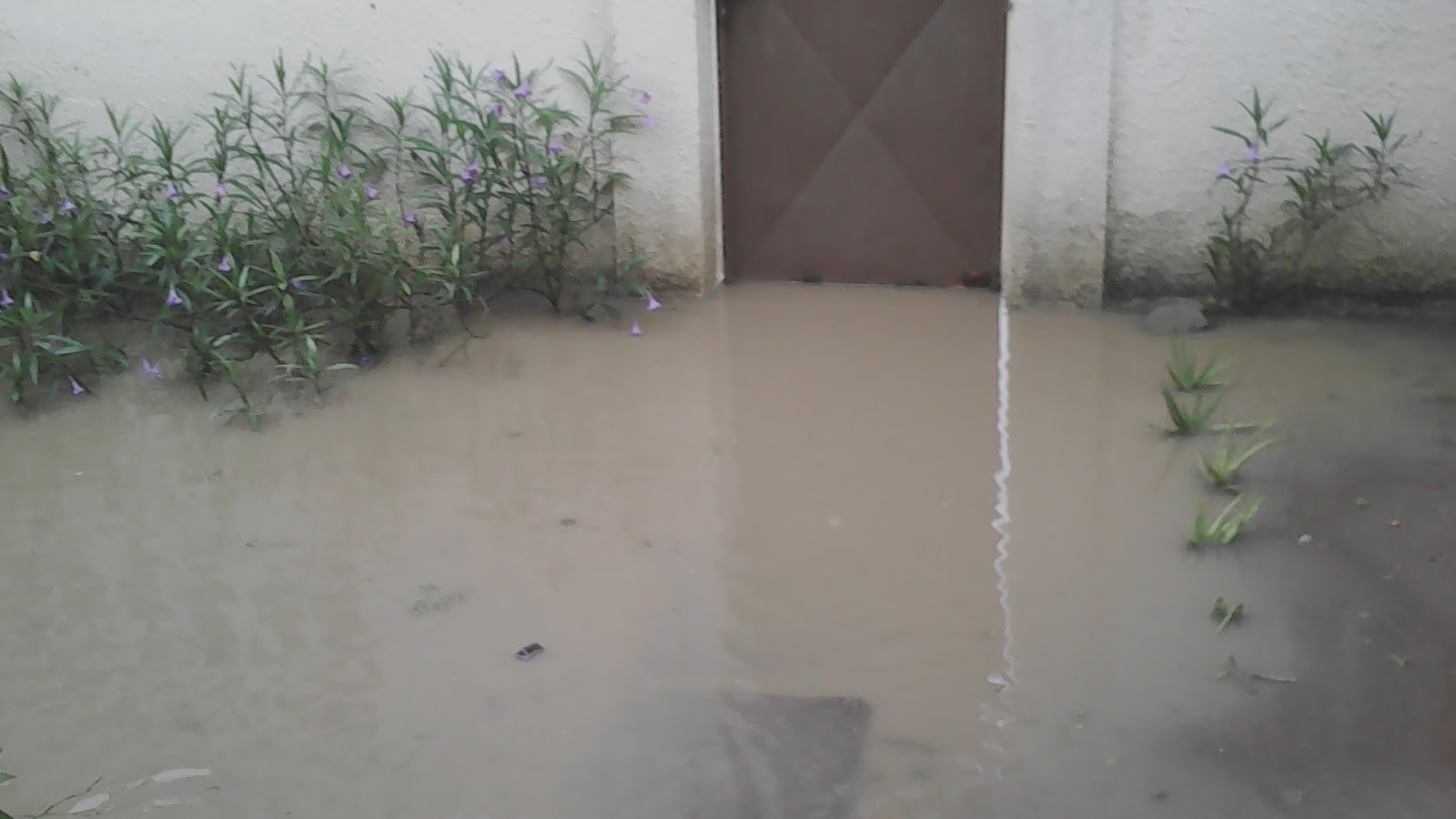 |
| our flooded walkway- although the morning of the crab sighting all was dry |
20.11.15
Expressing condolences
"Where are you from?" a colleague at work asked me as we crossed paths in the teacher's lounge.
It's a loaded question for us international types. "You mean.....originally?" I ask with hesitation coloring every word. I hate to be boxed in by my Americaness.
"I'm from the U.S., from New York." I am careful to put the U.S. first, having previously been called out after once replying simply, New York. Everyone knows NY, right? I've forgotten the exact remark, but it had something to do with us Americans putting state before country or assuming everyone has heard of our city, state, hometown. As if we are so important we don't even need a country. (I didn't mean it that way, but New York is kind of up there with Paris, London and Rome. Does it really need a preface?)
"I'm looking for the French. I want to express my condolences," my colleague goes on to say. I am momentarily stunned, but lately I've been seeing- and seizing- moments to talk about Congo with clarity and enthusiasm.
"Weelll.... I did just come from Kinshasa, in the DRC and they are suffering..." I begin to break the silence, telling him I am happy to accept his condolences on their behalf but we need to do more. He's a little unimpressed with my spiel. I sense he just wants to talk about Paris. "I understand," I tell him. "It's because we think certain places are safe. And when the safe places become victims, we feel all the more vulnerable."
"Yes." He smiles as though we have finally understood each other. "They're the guardians. And when the guardians get attacked it's not good."
The guardians? I can see we haven't understood each other at all. But I am trying. I know how hard it is to sustain a grief or outrage. If I came to you one day and said my brother died, you would respond heartfully. Maybe even so the next day, if I came to you again and said I'd lost another brother. Day 3 and 4, yet more brothers and sisters dying might leave you with an overwhelming sense of sympathy at my tragic state of affairs.
After 1 week however, you will begin avoiding me because you just don't know how to respond anymore. It's unimaginable what is happening to me- that so many in just one family would die like this, all close together. As week 2 continues you will put me neatly into the category of "other" and "alien" or "odd." You will have no choice but to move on to other things that are easier to think about. Things that require less emotional output and fewer feelings of helplessness.
But the tragedy continues. Our brothers and sisters continue dying everyday, and not just in Congo, but around the globe. How do we cope?
It's a loaded question for us international types. "You mean.....originally?" I ask with hesitation coloring every word. I hate to be boxed in by my Americaness.
"I'm from the U.S., from New York." I am careful to put the U.S. first, having previously been called out after once replying simply, New York. Everyone knows NY, right? I've forgotten the exact remark, but it had something to do with us Americans putting state before country or assuming everyone has heard of our city, state, hometown. As if we are so important we don't even need a country. (I didn't mean it that way, but New York is kind of up there with Paris, London and Rome. Does it really need a preface?)
"I'm looking for the French. I want to express my condolences," my colleague goes on to say. I am momentarily stunned, but lately I've been seeing- and seizing- moments to talk about Congo with clarity and enthusiasm.
"Weelll.... I did just come from Kinshasa, in the DRC and they are suffering..." I begin to break the silence, telling him I am happy to accept his condolences on their behalf but we need to do more. He's a little unimpressed with my spiel. I sense he just wants to talk about Paris. "I understand," I tell him. "It's because we think certain places are safe. And when the safe places become victims, we feel all the more vulnerable."
"Yes." He smiles as though we have finally understood each other. "They're the guardians. And when the guardians get attacked it's not good."
The guardians? I can see we haven't understood each other at all. But I am trying. I know how hard it is to sustain a grief or outrage. If I came to you one day and said my brother died, you would respond heartfully. Maybe even so the next day, if I came to you again and said I'd lost another brother. Day 3 and 4, yet more brothers and sisters dying might leave you with an overwhelming sense of sympathy at my tragic state of affairs.
After 1 week however, you will begin avoiding me because you just don't know how to respond anymore. It's unimaginable what is happening to me- that so many in just one family would die like this, all close together. As week 2 continues you will put me neatly into the category of "other" and "alien" or "odd." You will have no choice but to move on to other things that are easier to think about. Things that require less emotional output and fewer feelings of helplessness.
But the tragedy continues. Our brothers and sisters continue dying everyday, and not just in Congo, but around the globe. How do we cope?
17.11.15
Bowing to Kings
A mere 5 or so days after getting my computer back- all fixed and fresh with a crisp new screen- I broke it again. Yup, I broke it this time. I could get into the why's and how's and but it wasn't fair's, except that will only lead me down the road of discouragement and despair.
The positive thing about not having a computer at home is that I don't work all evening, every evening. It's not possible. When I go home at night to be with my family, the work stays in school- where it rightfully should.
Of course, it occasionally makes it hard to keep up with deadlines and I don't really enjoy spending every Sunday in my classroom- complete with cute little bunny in tow. It certainly makes writing for pleasure ever harder to get to, but...yeah, I was trying not to go down the road of despair.
The only things that offer true release from the world of work (aside from my little sunshine's laughter) is the world of dance. And drum. Music has a way of pushing all other things aside and claiming complete control.
I remember dancing in Congo- forever remember the zombie analogy- and see how far I have come. I actually miss Congolese dance, for one. The style and rhythms have helped me grow as a dancer in general.
My early teacher- a source of frustration for me at the time- has exploded into an amazing video choreographer and is working with a fabulous team in Belgium. I applaud her talent, her reaching for her dream and her success. Jolie is the shining star in many a video!
I am actually surprised at times by how much I miss Congo- and it's rhythms- especially since I recall the first year or so when my mind was colored by all things Guinean. It was hard to appreciate Kinshasa when my heart was aching for Conakry. But I am growing now and have found that loving dance and art and culture is a bit like being a parent. There is always room for the new and the old and the yet undiscovered.
These last few weeks, however, the drummers have been treating us with rhythms that remind me of my birth into the world of traditional dance. Oddly, I end up feeling a little nostalgic about African dance in New York. Moving across the floor as my body replays those steps from another time- it is like a warm and welcoming friend come to visit. When the teacher points me out to her group of young recruits and says, "She- she gets it. The only one." I know it is not fair. I want to tell her that the moves are good friends of mine. We go way back. I learned them long before coming to this class, this country, this time and space. But I remain silent, keeping our relationship hidden, secret and therefore all the more sacred.
At the same time, I have come to know some of the Ivorian dances pretty well. We are not lost in the jungle, bent-kneed and straight-backed zombies. Now- now we are peasants and villagers. We sow. We harvest. We cook and serve. We entice and praise. We dance with all the ordinariness of daily life and turn it into beauty. Most of the movements are low with a forward bend. Our backs pulse and arms circle out and around and in again. The movements are fluid and smooth, a perfect accompaniment to the drums. But we are never low enough.
"Get down,' our teacher will say. "You are bowing to kings." I've been keeping this piece of humility in mind as my reality spins out its tale. Yes, I am bowing to kings here in Abidjan. There are so many ways to interpret this- and currently my state of affairs fits them all.
The positive thing about not having a computer at home is that I don't work all evening, every evening. It's not possible. When I go home at night to be with my family, the work stays in school- where it rightfully should.
Of course, it occasionally makes it hard to keep up with deadlines and I don't really enjoy spending every Sunday in my classroom- complete with cute little bunny in tow. It certainly makes writing for pleasure ever harder to get to, but...yeah, I was trying not to go down the road of despair.
The only things that offer true release from the world of work (aside from my little sunshine's laughter) is the world of dance. And drum. Music has a way of pushing all other things aside and claiming complete control.
I remember dancing in Congo- forever remember the zombie analogy- and see how far I have come. I actually miss Congolese dance, for one. The style and rhythms have helped me grow as a dancer in general.
My early teacher- a source of frustration for me at the time- has exploded into an amazing video choreographer and is working with a fabulous team in Belgium. I applaud her talent, her reaching for her dream and her success. Jolie is the shining star in many a video!
I am actually surprised at times by how much I miss Congo- and it's rhythms- especially since I recall the first year or so when my mind was colored by all things Guinean. It was hard to appreciate Kinshasa when my heart was aching for Conakry. But I am growing now and have found that loving dance and art and culture is a bit like being a parent. There is always room for the new and the old and the yet undiscovered.
These last few weeks, however, the drummers have been treating us with rhythms that remind me of my birth into the world of traditional dance. Oddly, I end up feeling a little nostalgic about African dance in New York. Moving across the floor as my body replays those steps from another time- it is like a warm and welcoming friend come to visit. When the teacher points me out to her group of young recruits and says, "She- she gets it. The only one." I know it is not fair. I want to tell her that the moves are good friends of mine. We go way back. I learned them long before coming to this class, this country, this time and space. But I remain silent, keeping our relationship hidden, secret and therefore all the more sacred.
At the same time, I have come to know some of the Ivorian dances pretty well. We are not lost in the jungle, bent-kneed and straight-backed zombies. Now- now we are peasants and villagers. We sow. We harvest. We cook and serve. We entice and praise. We dance with all the ordinariness of daily life and turn it into beauty. Most of the movements are low with a forward bend. Our backs pulse and arms circle out and around and in again. The movements are fluid and smooth, a perfect accompaniment to the drums. But we are never low enough.
"Get down,' our teacher will say. "You are bowing to kings." I've been keeping this piece of humility in mind as my reality spins out its tale. Yes, I am bowing to kings here in Abidjan. There are so many ways to interpret this- and currently my state of affairs fits them all.
8.11.15
the boutique
"The boutique" is just another name for the corner store. And there really is one on every corner. In West Africa, these boutiques have a distinctive look. I keep wanting to take a picture but haven't figured out how to do that without changing our relationship. The picture I want is deep and inside. I want to sit and question, those American questions that can never be fully answered, because they are never completely understood. (part of me felt these things have already been uncovered- photographed, interviewed, explained- but a google search is turning up nothing. Might have to revisit the photograph series after all...)
It brings me back to one of my first experiences of this kind of all consuming work- El Salvadorains at a restaurant. The story I'd heard was one of our dishwashers had walked his way across the countr(ies) to somehow land in upstate NY. He found a place, as many did, washing dishes, bussing tables, doing anything that would bring in money. Eventually he was promoted to prep cook and cold cook until he was one day running the day time kitchen. Somewhere in between all of that I asked him if he enjoyed his job.Was it the life he'd envisioned for himself? Was it his dream? I wanted to know. Was he happy?
Even as I asked, I realized the futility of my question. I'd heard they all shared a room in a hollowed out, vacant restaurant- 10 of them sharing space by candlelight just to crash for the night before returning to their 14 hour shifts. Americans search for personal happiness, but immigrants search for happiness thorugh service to their families. Yes, he said. He was happy. He had a job that allowed him to send money home. Mission accomplished.
But then, as now and every moment in between, I wonder about my ability to be satisified through my occupation. Is it enough? I ask. What's the purpose? I don't want my life to be consumed with working.
Whenever I am feeling particularly overtaxed in this regard, I have only to look to my neighborhood boutique.
West African boutiques are always framed with bars. These are not stores you enter but stores you stand outside. You look in through the bars and ask for items you want to purchase. The storekeeper will pull them down and offer them to you through one section of bars that is larger than all the rest. A "window" for larger purchases. The actual door is often locked and the keeper is inside, surrounded by piles of goods and stocks of merchandise wanting to be sold.
Though the size varies, there is always that sense of a cage. Sometimes the vendor will sit outside in a chair, ever ready to jump up and assist a consumer. Sometimes there are two and they will trade conversation and keep good company.
But if I focus in on just this one store, the one closest to me, I sesne an ever more lonely tale. There used to be two- but one was sent out to man another shop and so now there is one. He seems rather young to me and so confined. I see him sometimes praying outside in the early morning, or leaving his space on Fridays to go to the mosque. On these days he seems even smaller, younger, more vulnerable without the shape of his boutique to surround him.
Mostly I see him inside, sitting on a straightback wooden chair surrounded by high piles of boxes and endless crates of soda. There is barely room for him inside, especially when a shipment has just come in. He has a cookstove and a small television. Nothing about the set-up looks cozy or comforting. There is no couch, no walls with paintings or photographs. He has no kitchen or dining room or living room. He has just the boutique.
I've asked random questions, trying to get a more complete picture. At times the door is closed, leaving only the window open. He tells me at night, if he is at the window, kids will come and steal things out of the open doorway if he doesn't lock it. The same neighborhood kids who buy from him all day turn against him under cover of darkness. There isn't anger in his response, just acceptance. He has adapted.
I ask him what time he closes and he tells me 11:00. It seems so late, especially since I know his doors open at 6:00 or 6:30. So when do you sleep? I ask. 11:30 he responds in complete seriousness. I sense a rigid routine in there and all my regrets about working too much fly out the window. 6-11.00- no breaks, except on Fridays.
He is chained to this place. One night, one night out of the 365+ days I have lived here- I saw a girl in there. She was sitting in a hard backed chair next to his, nestled in amongst the cartons of Awa and the gallon of oil that is expressed into individual bags to be sold for quantities starting at 100franc. She was there and they were watching tv together. I don't know what their relationship was and I can't even begin to guess. I've never seen her again- or anyone else.
I have heard the small snippets of conversation that pass between him and neighborhood buyers- from flirtations with girls to indiginant drunken young men who insist their importance as consumers far outweighs his as supplier ("if it weren't for us, you wouldn't be here..." one young someone began...and went on and repeated until it was obvious he just wanted to purchase on credit.)
I approach the bars from outside and can't help but imagine what it is like from within. Every day, every hour and every minute tied to this existence. It is not his store, which makes it all the more difficult to comprehend. The lonliness, the routine, the unchanging drudgery of it all.
I wonder if he dreams of a wife, a family, a life apart from this. I wonder about friends and parents and his connection to the owner. Did they know each other? Are they related and is it a family obligation that keeps him here? This is when I begin to understand the reason for taking things day by day. For not planning too far ahead, not dreaming or envisioning- what is beyond these cartons?
But surely he must? Somewhere there is a faith that this will one day give way to something greater. A knowledge that the routines of today can be changed in an instant, giving way to the dreams of tomorrow. I haven't yet found a way to inquire- my weird American questions revealing a truth best left uncovered.
It brings me back to one of my first experiences of this kind of all consuming work- El Salvadorains at a restaurant. The story I'd heard was one of our dishwashers had walked his way across the countr(ies) to somehow land in upstate NY. He found a place, as many did, washing dishes, bussing tables, doing anything that would bring in money. Eventually he was promoted to prep cook and cold cook until he was one day running the day time kitchen. Somewhere in between all of that I asked him if he enjoyed his job.Was it the life he'd envisioned for himself? Was it his dream? I wanted to know. Was he happy?
Even as I asked, I realized the futility of my question. I'd heard they all shared a room in a hollowed out, vacant restaurant- 10 of them sharing space by candlelight just to crash for the night before returning to their 14 hour shifts. Americans search for personal happiness, but immigrants search for happiness thorugh service to their families. Yes, he said. He was happy. He had a job that allowed him to send money home. Mission accomplished.
But then, as now and every moment in between, I wonder about my ability to be satisified through my occupation. Is it enough? I ask. What's the purpose? I don't want my life to be consumed with working.
Whenever I am feeling particularly overtaxed in this regard, I have only to look to my neighborhood boutique.
West African boutiques are always framed with bars. These are not stores you enter but stores you stand outside. You look in through the bars and ask for items you want to purchase. The storekeeper will pull them down and offer them to you through one section of bars that is larger than all the rest. A "window" for larger purchases. The actual door is often locked and the keeper is inside, surrounded by piles of goods and stocks of merchandise wanting to be sold.
Though the size varies, there is always that sense of a cage. Sometimes the vendor will sit outside in a chair, ever ready to jump up and assist a consumer. Sometimes there are two and they will trade conversation and keep good company.
But if I focus in on just this one store, the one closest to me, I sesne an ever more lonely tale. There used to be two- but one was sent out to man another shop and so now there is one. He seems rather young to me and so confined. I see him sometimes praying outside in the early morning, or leaving his space on Fridays to go to the mosque. On these days he seems even smaller, younger, more vulnerable without the shape of his boutique to surround him.
Mostly I see him inside, sitting on a straightback wooden chair surrounded by high piles of boxes and endless crates of soda. There is barely room for him inside, especially when a shipment has just come in. He has a cookstove and a small television. Nothing about the set-up looks cozy or comforting. There is no couch, no walls with paintings or photographs. He has no kitchen or dining room or living room. He has just the boutique.
I've asked random questions, trying to get a more complete picture. At times the door is closed, leaving only the window open. He tells me at night, if he is at the window, kids will come and steal things out of the open doorway if he doesn't lock it. The same neighborhood kids who buy from him all day turn against him under cover of darkness. There isn't anger in his response, just acceptance. He has adapted.
I ask him what time he closes and he tells me 11:00. It seems so late, especially since I know his doors open at 6:00 or 6:30. So when do you sleep? I ask. 11:30 he responds in complete seriousness. I sense a rigid routine in there and all my regrets about working too much fly out the window. 6-11.00- no breaks, except on Fridays.
He is chained to this place. One night, one night out of the 365+ days I have lived here- I saw a girl in there. She was sitting in a hard backed chair next to his, nestled in amongst the cartons of Awa and the gallon of oil that is expressed into individual bags to be sold for quantities starting at 100franc. She was there and they were watching tv together. I don't know what their relationship was and I can't even begin to guess. I've never seen her again- or anyone else.
I have heard the small snippets of conversation that pass between him and neighborhood buyers- from flirtations with girls to indiginant drunken young men who insist their importance as consumers far outweighs his as supplier ("if it weren't for us, you wouldn't be here..." one young someone began...and went on and repeated until it was obvious he just wanted to purchase on credit.)
I approach the bars from outside and can't help but imagine what it is like from within. Every day, every hour and every minute tied to this existence. It is not his store, which makes it all the more difficult to comprehend. The lonliness, the routine, the unchanging drudgery of it all.
I wonder if he dreams of a wife, a family, a life apart from this. I wonder about friends and parents and his connection to the owner. Did they know each other? Are they related and is it a family obligation that keeps him here? This is when I begin to understand the reason for taking things day by day. For not planning too far ahead, not dreaming or envisioning- what is beyond these cartons?
But surely he must? Somewhere there is a faith that this will one day give way to something greater. A knowledge that the routines of today can be changed in an instant, giving way to the dreams of tomorrow. I haven't yet found a way to inquire- my weird American questions revealing a truth best left uncovered.
The miracle of night
Mostly, Africa is home. And I do mean that in the broad sense of the continent. While the country may change, my ears and eyes bring in information through an African context. I am not hearing the same anymore. When I talk to my colleagues, I am often filtering though layers - and sometimes tuning out altogether- because the basis from which I try to relate has shifted completely. Often I simply do not arrive. We are no longer the same, those ex-patriots and I. Somewhere along the way I moved across boundaries and became less of an ex-pat and more of an immigrant. (The buzz around those terms is an ongoing debate and I"m not sure what I agree with or where I fall, but you can read about it here, here and here.)
It's something I have reflected on since moving to Africa- and possibly having to face the choice of fleeing in the name of conflict (there was this post in 2009.) In my current set-up, there's no question. We are here. Fleeing is not an option and there is no agency who can or will help us.
But I am good with that. We don't want to flee (or so I like to think. At least one of us Soumahs would probably jump at the chance to get out of here and I am trying to come to terms with that so if the opportunity presents itself, I will be lovingly supportive and not tearfully distraught.)
Every so often though, in the name of this blog and unknown future written representations- I try to see again through my outsider eyes. I try to get back that magic that Africa held when she was slightly unknown but ever enchanting. The past few weeks, as I have rounded the corner of my small dirt street and made my way home in the dark evening night, I am greeted with a sight that is surely "other," though for us it now just is.
You can almost tell time by it and more than once the boys have questioned why I don't join in- which brings a small smile to my face.
The house across the street (street feels like a big word for the small dirt path that separates us) is home to babies. I've been half-heartedly trying to count them- or at least be aware of how many there actually are- but when one of my observations noted another pregnant women I decided to just give up. There are a lot. 3 or 4. I heard the newborn baby cries and I see the mamas outside with month old cuties wrapped in their white blankets. I have not been able to determine what the house is- one thing I've learned about outside appearance- they give no clue as to inside inhabitants. I can't tell if the doorway leads to one apartment or many- if it is one family related or merely neighbors. What I know is there are babies, and they go to bed around 7.
I know this because if you round the corner between 7 and 8 you will see the women outside. They have the babies strapped to their backs and they are pacing, or rocking or just gazing at the moon. It is time for the babies to sleep so they take them outside and give them fresh air and quiet night filled only with far-away neighborhood sounds. I know enough now to suppose the women are not necessarily the moms, though perhaps they could be.
And I view this ritual from the future persepective. What memories will the babies hold of the cool night wind blowing in off the lagoon- soothing, refreshing, lulling them to sleep alongside the distant drums and steady rhythms of a hip-hop beat, calling children and barking dogs, men laughing and an occasional horn honking.
It's cozy and comforting. I understand why the boys want me to take Mbalia out to walk through the night sounds as she transitions into the world of dreaming with nature and man in it's most harmonious time.
I don't do it. It is one of those bridges I can't be expected to cross. We've begin developing our own nighttime routine- sometimes it works, and sometimes it doesn't.
But I do enjoy the sight- the babies out for their evening stroll while their mamas talk on the phone or text someone or simply gaze out at the universe, contemplating the miracle of night.
It's something I have reflected on since moving to Africa- and possibly having to face the choice of fleeing in the name of conflict (there was this post in 2009.) In my current set-up, there's no question. We are here. Fleeing is not an option and there is no agency who can or will help us.
But I am good with that. We don't want to flee (or so I like to think. At least one of us Soumahs would probably jump at the chance to get out of here and I am trying to come to terms with that so if the opportunity presents itself, I will be lovingly supportive and not tearfully distraught.)
Every so often though, in the name of this blog and unknown future written representations- I try to see again through my outsider eyes. I try to get back that magic that Africa held when she was slightly unknown but ever enchanting. The past few weeks, as I have rounded the corner of my small dirt street and made my way home in the dark evening night, I am greeted with a sight that is surely "other," though for us it now just is.
You can almost tell time by it and more than once the boys have questioned why I don't join in- which brings a small smile to my face.
The house across the street (street feels like a big word for the small dirt path that separates us) is home to babies. I've been half-heartedly trying to count them- or at least be aware of how many there actually are- but when one of my observations noted another pregnant women I decided to just give up. There are a lot. 3 or 4. I heard the newborn baby cries and I see the mamas outside with month old cuties wrapped in their white blankets. I have not been able to determine what the house is- one thing I've learned about outside appearance- they give no clue as to inside inhabitants. I can't tell if the doorway leads to one apartment or many- if it is one family related or merely neighbors. What I know is there are babies, and they go to bed around 7.
I know this because if you round the corner between 7 and 8 you will see the women outside. They have the babies strapped to their backs and they are pacing, or rocking or just gazing at the moon. It is time for the babies to sleep so they take them outside and give them fresh air and quiet night filled only with far-away neighborhood sounds. I know enough now to suppose the women are not necessarily the moms, though perhaps they could be.
And I view this ritual from the future persepective. What memories will the babies hold of the cool night wind blowing in off the lagoon- soothing, refreshing, lulling them to sleep alongside the distant drums and steady rhythms of a hip-hop beat, calling children and barking dogs, men laughing and an occasional horn honking.
It's cozy and comforting. I understand why the boys want me to take Mbalia out to walk through the night sounds as she transitions into the world of dreaming with nature and man in it's most harmonious time.
I don't do it. It is one of those bridges I can't be expected to cross. We've begin developing our own nighttime routine- sometimes it works, and sometimes it doesn't.
But I do enjoy the sight- the babies out for their evening stroll while their mamas talk on the phone or text someone or simply gaze out at the universe, contemplating the miracle of night.
Subscribe to:
Posts (Atom)