Since my last post, the list of miss vs. not miss has grown like wild fire. I've started making notes in my phone for an anticipated numbered account. Essential oils in the pharmacies is definitely going to make the miss list. Hugely.
I was on my way to the pharmacy during my lunch break yesterday, in search of a certain lavender neroli blend my yoga teacher uses, when I noticed them. In their black and gray marbled uniforms, the police sitting just at the end of the school parking lot stood out distinctly from our daily security, who wear canary yellow shirts and typical guardian gray pants with a black stripe down the side.
The policemen, about 5 of them, were all lined up in blue chairs looking bored out of their minds, a few actually napping in the shade. I have noticed a greater police presence, truckloads full sitting at corners and patrolling the streets. It doesn't feel like so many, but because there are usually none, the contrast is noticeable. I can't help but think of Kinshasa where the presence of military, police, guns and even the occasional tank were an everyday affair. It was only when the riot gear came out that we began to suspect something was up.
There's mutiny in Cote d'Ivoire and it has everyone on edge, wondering what will happen next. I am reminded this is the way of Africa, everything is fine until it's not. Apparently it began with the military going on strike in order to receive promised pay that never materialized. The president seemed to issue a super swift response (a good decision when guns are involved) acquiescing to the demand. It turns out, he only approved some of the pay, for some of the people (probably not such a good decision when guns are involved.)
In conjunction with, or directly because of (it's hard to be clear on the sequence of events) other government-paid entities went on strike as well. Doctors-this one actually stumped me for a minute, but when even the street roaming telephone credit sellers can go on strike, you know anything is possible. I hadn't realized doctors were paid by the government. I'm still not certain I completely understand that whole situation. UPDATE: Apparently the doctors are subsidized by the state- some of their pay comes from the government and some comes from the patients themselves. Oddly, the patients don't receive subsidized care. If you don't have money, you don't get treatment. And in these days, money won't help you much either. A strike is going on.
Teachers- this strike led to altercations between public and private schools, with the former insisting the latter strike to support them. This article and video describe a disturbing scene at a school in the area. Students became the clear victims of a matter that should remain between adults.
Conflict and tension are not just elevated on school grounds. The comments on this article reflect some of the challenges that occur when a country's military goes on 'strike'- effectively a mutiny when the people charged with protecting you are refusing to do so. The problem, common to many African militaries, is that a certain number of members have come in as 'rebels.' It results in a complex relationship between the incumbent president and the old and new guards. It seems like it should have been obvious to the president that if he only paid a few of them, the rest were not going to be happy. Likewise, once you pay out to a strike, it kind of opens the floodgates for others seeking their remittance. (Of course, the whole messy situation could be avoided by.....simply paying salaries on time in the first place, non?)
What remains impressive is the level of organisation inherent in the strikes, which included the administrative and finance capitals as well as the 'second city.' Rumors abound as to what will happen next. Although our director has been walking around all day and sending curious emails trying to staunch the flow of rumors, the fact is that in Africa rumors can be difficult to determine. Word of mouth is often the only reliable way to get messages around (especially in the face of presidents and the powerful who are known to cut off text messaging, internet connections and t.v/radio service.) We're all left trying to determine how to tell if something is rumor or merely truth traveling the old fashioned way?
Like much else in Africa, it all goes back to your connections. If your roots are deep, you will find water. For the rest of us? We're stuck just waiting it out, watching play by play and speculating on the possible outcomes. It's either that or the CAN.
Showing posts with label strikes. Show all posts
Showing posts with label strikes. Show all posts
18.1.17
1.6.12
A Battle of Law and Order
While war rages in the east, a different kind of battle is taking over Kinshasa. Kintambo Magasin is often a place of congestion- too many cars, too many people and a collection of crossroads designed to inhibit rather than facilitate the coming together of all these parties. Add to it the occasional surprise road construction project and you have the perfect confection of random chaos. So I was filled with curiosity and wonder when I drove with ease through the normally congested market area and was greeted with quiet, empty streets. I must qualify my description, which I am tempted to continue with ghost-town like qualities, by saying there were still pedestrians taking over the roadway and taxis stopping midstream in search of passengers. It was by no means deserted. However, the central square held simmering remnants of smouldering belongings and the blue uniforms of police flanked with neon yellow crossing vests were roaming in alarming numbers. Something was up.
Kintambo had been home to a small marketplace of vegetable and fruit stands, bread sellers and apple carts. You could usually find ice cream vendors, phone card and money exchange tables and a variety of miscellaneous wares filling the roadside. But not this day. I pondered the disappearance of the street sellers while the drifting smoke lent an ominous feel to the now deserted streets.
After searching a bit online, I found this small report about the city wide action. Several vendors report losing their merchandise to police who either confiscated or burned their wares. Apparently it was a government order intended to clear up the major arteries and create safer, cleaner streets.
While trying to quell my initial outrage and search for a reasonable reaction, I conducted a small, informal poll. These results seemed to match comments on the Okapi site. In general, people agree that something needed to be done to make the areas safer for all involved. It is the approach that was lacking. I can't help but empathize with feelings of injustice for the Congolese who have managed to eke out a living....coupled with my previous concern that the influx of supermarkets would overtake whatever business these entrepreneurs had managed to build up. To say nothing of the fact that the streets, while unarguably less crowded, haven't appeared any cleaner since the demolition.
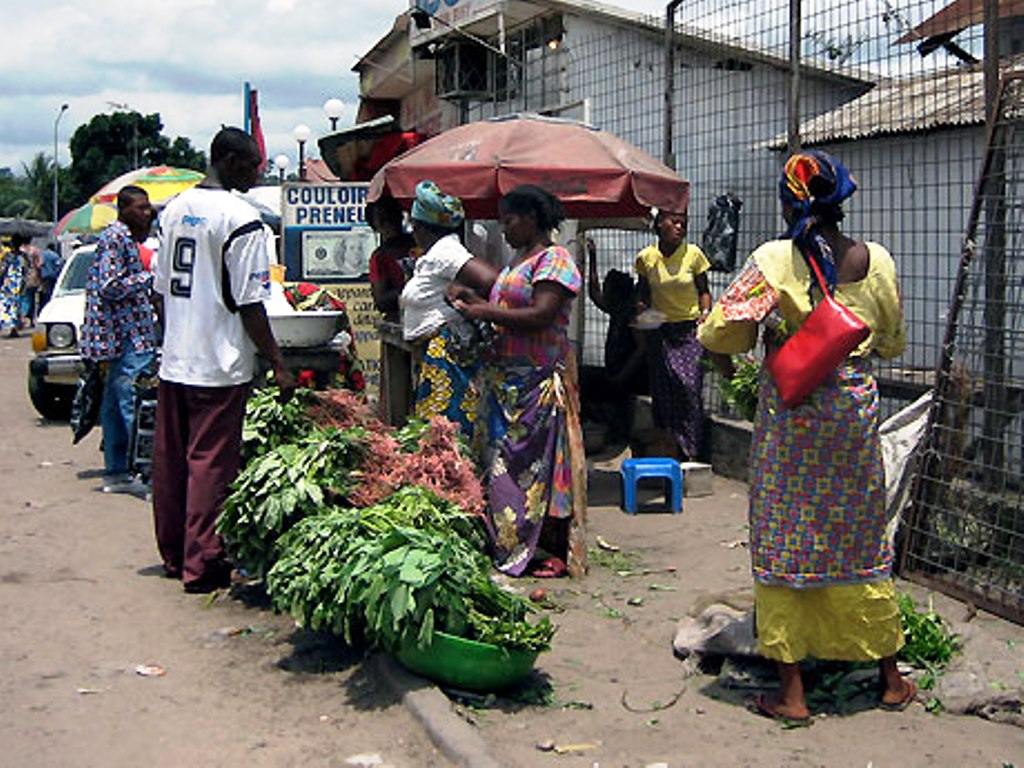
Kintambo used to look something like this:
Admittedly, this photo shows an area remarkably cleaner and less crowded than the reality. In addition to the walk up buyers, the proximity to passing cars often encouraged a kind of drive by shopping as well. Now, the once busy women sit dejectedly on the stone steps just across the street, hiding under store front overhangs, leaning hopelessly against the cement walls trying to peddle a few bananas from baskets on their laps. They look lost and homeless.
Something similar happened a few years ago to the vendors at the Marche de Valeur downtown. Their market had been more defined but equally ill placed. It was a dingy, crowded collection of artists and craftspeople set in the center of downtown just by the Gare Central. They were removed, disappeared for awhile as new construction began in the building of a large fountain and vast sitting area. The Marche de Valeur can now be found several blocks further up the boulevard. There is parking, more room to walk, browse and display work and in general a cleaner, safer feel to the whole experience. And so I have been wondering why the same couldn't be done for the marketers in Kintambo. I think back to fond memories of farmer's markets in the U.S. and how parking lots are taken over or whole streets even closed for the weekly event. Of course, one day a week would not be enough for these women and men who spent their days selling and chatting under umbrellas and their nights huddled by kerosene and candle light. (I never could figure out when the market "closed.") But surely there is an area available where people could have been moved to and customers could easily find and continue to support them.
Just days after the imposition of the new orders, the taxi drivers went on an unheard of two day strike. I conducted another small, informal poll to try and determine their demands. (How would they know when to stop striking? Well, if the pressure of earning a living and providing daily food for their families wasn't so great and they could actually make a sustained statement.) Answers here were much more varied and vague. Many people suggested it had something to do with the demands by police to see the infamous "carte rouge" the rose colored card that proves one is insured. The typical routine is for police to stop, demand and wait for some kind of tip to overlook the fact that a driver may not actually have this card available. Aside from the tipping aspect of this scenario, it reminds me of the inspection stops that seem to pop up near the end of the month in the states. Just as these check-ins are rumored to be caused by police needing to fill a quota of traffic tickets, speculation abound as to the real cause of the strikes. Alex describes it best.
I heard many suggestions that the strike was related to the cost of insurance and the impossibility for acquiring and maintaining it. It's a bit harder to empathize here, as carrying insurance seems a necessity when considering the attitude and outrageous actions of many taxi drivers. Those polled seemed to feel the same way. If you can't afford insurance, you can't afford to drive. My favorite supposed cause for the taxi strike surmised that the drivers were, in fact, supporting the cause of the street vendors and trying to make a statement on their behalf.
Despite my new found addiction to morning boiled plantains being ever harder to fill without the nearby market, I grudgingly admit that change is good. Streets do need to be safer for pedestrians and drivers, motorists do need to carry insurance and the police are the most logical to enforce these rules. But ah, the growing pains of bringing law and order to the wild west.
Kintambo had been home to a small marketplace of vegetable and fruit stands, bread sellers and apple carts. You could usually find ice cream vendors, phone card and money exchange tables and a variety of miscellaneous wares filling the roadside. But not this day. I pondered the disappearance of the street sellers while the drifting smoke lent an ominous feel to the now deserted streets.
After searching a bit online, I found this small report about the city wide action. Several vendors report losing their merchandise to police who either confiscated or burned their wares. Apparently it was a government order intended to clear up the major arteries and create safer, cleaner streets.
 |
| photo by radio okapi - destruction of an outdoor eatery |
 | |
Admittedly, this photo shows an area remarkably cleaner and less crowded than the reality. In addition to the walk up buyers, the proximity to passing cars often encouraged a kind of drive by shopping as well. Now, the once busy women sit dejectedly on the stone steps just across the street, hiding under store front overhangs, leaning hopelessly against the cement walls trying to peddle a few bananas from baskets on their laps. They look lost and homeless.
Something similar happened a few years ago to the vendors at the Marche de Valeur downtown. Their market had been more defined but equally ill placed. It was a dingy, crowded collection of artists and craftspeople set in the center of downtown just by the Gare Central. They were removed, disappeared for awhile as new construction began in the building of a large fountain and vast sitting area. The Marche de Valeur can now be found several blocks further up the boulevard. There is parking, more room to walk, browse and display work and in general a cleaner, safer feel to the whole experience. And so I have been wondering why the same couldn't be done for the marketers in Kintambo. I think back to fond memories of farmer's markets in the U.S. and how parking lots are taken over or whole streets even closed for the weekly event. Of course, one day a week would not be enough for these women and men who spent their days selling and chatting under umbrellas and their nights huddled by kerosene and candle light. (I never could figure out when the market "closed.") But surely there is an area available where people could have been moved to and customers could easily find and continue to support them.
 | |||
| Farmer's Markets help everyone- buy local, eat fresh |
Just days after the imposition of the new orders, the taxi drivers went on an unheard of two day strike. I conducted another small, informal poll to try and determine their demands. (How would they know when to stop striking? Well, if the pressure of earning a living and providing daily food for their families wasn't so great and they could actually make a sustained statement.) Answers here were much more varied and vague. Many people suggested it had something to do with the demands by police to see the infamous "carte rouge" the rose colored card that proves one is insured. The typical routine is for police to stop, demand and wait for some kind of tip to overlook the fact that a driver may not actually have this card available. Aside from the tipping aspect of this scenario, it reminds me of the inspection stops that seem to pop up near the end of the month in the states. Just as these check-ins are rumored to be caused by police needing to fill a quota of traffic tickets, speculation abound as to the real cause of the strikes. Alex describes it best.
I heard many suggestions that the strike was related to the cost of insurance and the impossibility for acquiring and maintaining it. It's a bit harder to empathize here, as carrying insurance seems a necessity when considering the attitude and outrageous actions of many taxi drivers. Those polled seemed to feel the same way. If you can't afford insurance, you can't afford to drive. My favorite supposed cause for the taxi strike surmised that the drivers were, in fact, supporting the cause of the street vendors and trying to make a statement on their behalf.
Despite my new found addiction to morning boiled plantains being ever harder to fill without the nearby market, I grudgingly admit that change is good. Streets do need to be safer for pedestrians and drivers, motorists do need to carry insurance and the police are the most logical to enforce these rules. But ah, the growing pains of bringing law and order to the wild west.


Subscribe to:
Posts (Atom)